Hammer Film Productions is the British studio primarily known for breathing new life into classic movie monsters that were generally Universal’s forte over in the States with their gory color productions beginning in the late 1950s such as The Curse of Frankenstein, Dracula, and many others. But while in the decades since Hammer horror has almost become a genre in and of itself, the studio never limited itself solely to horror films. In fact, one of its most criminally unsung productions is a lean black-and-white heist thriller, 1961’s Cash on Demand.
Cash on Demand is set two days before Christmas. In fact, the opening shot of the movie is of a street corner Santa ringing his bell as the snow pours down, the camera traveling from outside to inside the bank where the remainder of the narrative is set. The bank’s employees are eagerly anticipating Christmas and their holiday party, but their manager Harry Fordyce (Hammer regular Peter Cushing) is as Scrooge-like as they come. In fact, once he enters the office, he insists on calling out his employees on their failings, even threatening his head clerk, Pearson (Richard Vernon) with his firing for a minor offense. But despite his chilly exterior, there’s a streak of humanity still present in Fordyce that had long laid dormant in Ebenezer when A Christmas Carol opens: when he sits down at his desk, we glimpse photographs of his wife and child sitting prominently on top of it. When a man claiming to be an insurance investigator, Gore Hepburn (Andre Morell) unexpectedly shows up, Fordyce begins perfunctorily going over the books with him. But Hepburn fast reveals himself to not be an insurance man but a crook aiming to rob the bank of £93,000 in bank notes, and he needs a man on the inside to assist him. He tells Fordyce that an accomplice is holding his family hostage, and Fordyce, whose austere manner quickly crumbles under pressure and fear, reluctantly begins helping Hepburn rob his own bank.

Cash on Demand never beats you over the head with its holiday setting, although the snow storm perpetually visible through the windows of the bank certainly sets the mood, and family and positive change is an integral theme of the film. Even Hepburn immediately notices Fordyce’s coldness toward others, calling him out on his lack of compassion which he cops as a byproduct of his insecurity; at one point, when Fordyce tells him that the opinion of a “common thief” means nothing to him, Hepburn responds, “I can’t help interesting myself in people. It’s a failing you ought to cultivate.” The question of whether or not this harrowing experience will prompt Fordyce to change his ways— or if his demeanor will be his downfall— is one that hangs over the entirety of Cash on Demand and contributes to the tension that permeates it.
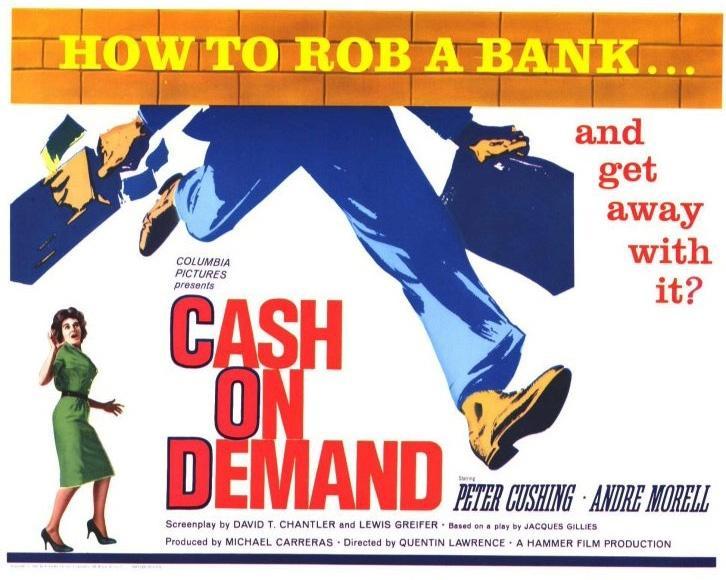
Even if the holiday setting wasn’t present to add another layer to the film, Cash on Demand is still a remarkably efficient and effective one-setting thriller. This was one of only a handful of films that English director Quentin Lawrence made (he primarily worked in television), but he makes great use of the space of the bank’s interior, the layout of which becomes integral to the plot. The script (the story is based on a 1960 teleplay titled The Gold Inside) is engaging, despite this being primarily a story of two men engaging in a battle of the wits. Cushing and Morell play off each other brilliantly, although this wasn’t the first time they had worked together (they also played the dynamic duo of Sherlock Holmes and Doctor Watson’s in Hammer’s terrific 1959 adaptation of The Hound of the Baskervilles). Cushing had a career brimming with variety (although he’s probably most recognized by audiences today as Grand Moff Tarkin in 1977’s Star Wars), but he has arguable never been more elite than he is in Cash on Demand. It’s remarkable what he conveys by adding just a slight jitteriness to his gesture and his voice. Even his distinctive, hawk-like face and beady eyes are perfectly suited to the character of Fordyce, and when, at one point, Hepburn resorts to a sudden burst of physical violence, and we glimpse the tears that suddenly spring to Fordyce’s eyes— well, that’s just great screen acting, folks. If you’re a Hammer completionist, or someone just looking for a solid alternative Christmas film, Cash on Demand is a wonderful gem.
Cash on Demand is currently streaming for free on Tubi. Runtime: 80 minutes (note that there are various cuts of the film that vary in length, but the USA release is 80 minutes long).

 Katie at the Movies