“The murder plots depended upon doctors who falsified death certificates and upon undertakers who quickly and quietly buried bodies. The guardian who McAuliffe suspected of killing his grandmother was a prominent attorney working for the tribe who never interfered with the criminal networks operating under his nose. Nor did bankers, including the apparent murderer Burt, who were profiting from the criminal ‘Indian business.’ Nor did the venal mayor of Fairfax—an ally of Hale’s who also served as a guardian. Nor did countless lawmen and prosecutors and judges who had a hand in the blood money. In 1926, the Osage leader Bacon Rind remarked, ‘There are men amongst the whites, honest men, but they are mighty scarce.’ Garrett Bailey, a leading anthropologist on Osage culture, said to me, ‘If Hale had told what he knew, a high percentage of the county’s leading citizens would have been in prison.’ Indeed, virtually every element of society was complicit in the murderous system.”
-David Grann, Killers of the Flower Moon
David Grann closes his 2017 book Killers of the Flower Moon, a nonfiction account of the Osage murders, with a chapter that conveys the ripple effect the incident, nearly a century in the past now, continues to have on members of the Osage Nation in Oklahoma. Forced from their ancestral land and resettled in northern Oklahoma by the United States government, oil was eventually discovered on the new reservation, and each member of the tribe was granted headrights that paid out annual royalties. As the oil market boomed, so did Osage wealth, and by the 1920s, they were the richest people per capita on the planet. The Osage fashioned themselves in an image antithetical to the perception most white citizens held of them as wild people: they dressed in fine clothes and jewelry, owned multiple cars and grand houses, employed servants, and sent their children to fancy boarding schools. And just as they did before, white people inserted themselves into their environment, manipulating and eventually murdering their way through the population to claim the Osage wealth that they felt entitled to for themselves. There were around two dozen confirmed murders of Osage people during what became known as the Reign of Terror, predominantly taking place between 1921 and 1926, but the estimates of Osage deaths that were unconfirmed killings—staged suicides, poisonings made to look like illness, and the like—are somewhere in the hundreds. There are still Osage today trying to uncover what really happened to their deceased family members during that time.
Grann’s book is an immensely riveting read, but also a revelatory one, the sort that provokes cries of “how did I not know this?” Of course, it’s no surprise that this piece of history has been buried by time, especially in an America where white narratives have dominated the history books for so long. The story of the Osage murders has cropped up in various media every so often across the decades—I wrote about its brief and flawed depiction in the 1959 movie The FBI Story earlier this year—but Grann’s book was the deep dive we’ve been lacking. The film rights to it were snatched up as early as 2016, and after years of development and COVID-related pauses, director Martin Scorsese’s Killers of the Flower Moon is finally here. Scorsese’s film is many things, including an extension of the crime dramas he’s predominantly recognized for, but it is also a fascinating exercise in adaptation.

Scorsese and co-writer Eric Roth demur from a straight adaptation of Grann’s book, using it instead as a jumping off point to reframe the narrative almost entirely. In the book, Grann primarily follows two threads: that of Mollie Burkhart, an Osage woman who married a white man, Ernest, and whose entire family became the main target of Ernest’s two-faced cattle baron uncle, William Hale; and Tom White, an agent of the fledging FBI sent by J. Edgar Hoover to investigate the murders. The book frequently reads like a thriller, and Grann teases out the identity of who’s behind the killings over of the course of its 316 pages. Scorsese, on the other hand, wastes no time letting the audience know that Hale (played by Robert De Niro in his tenth collaboration with the director) is the mastermind behind it all, positioning himself as a friend of the Osage and a respected member of the community while making arrangements to secure their headrights for himself behind closed doors. When Ernest (Leonardo DiCaprio) meets with Hale at the start of the film, newly returned from the war, Hale—for whom De Niro strikes just the right balance of outward benevolence neatly covering simmering hate and greed, right down to insisting that Ernest refer to him by the nickname he always called him as a child, “King”—lightly suggests that Ernest insinuate himself with an Osage woman, and after Ernest begins courting Mollie (Lily Gladstone), Hale leans into the notion that the two should marry even harder. The film spends a lot of time with Ernest and Hale—we often see Hale orchestrating hits before they happen, and occasionally watch Ernest and his colleagues carry out the jobs unbeknownst to his Osage family members—so the narrative becomes less about who is complicit, and more about who isn’t. By letting the audience in on the behind-the-scenes machinations, Scorsese crafts about as damning a portrait of the violence wrought by white supremacy as it gets, and the film’s massive runtime—an unhurried three hours and twenty-six minutes—plays into that. You feel the length, but not in a way that suggests the film is poorly paced, or doesn’t warrant the time it takes. It’s punishing, seeing Hale and his gang get away with so much for so long, watching no one doing anything about it, and Scorsese makes us bear witness to the devastating scope of their evil deeds, rooted in America’s original sin, occurring over the course of years that just slip by, the only real time-orienting event happening when the characters sit in a theater passively watching a newsreel of another racially-motivated crime, the 1921 destruction of Black Wall Street, a thriving Black community in nearby Tulsa.
While many of Scorsese’s previous films that center on crime families do drum up some empathy for the characters, such as Mean Streets and Goodfellas, there’s no sympathy to be found for the villains of Killers of the Flower Moon. And while pushing the story of Tom White (played by the always reliable Jesse Plemons) and the FBI’s involvement in the case into a supporting thread that doesn’t really come into play until the film’s final hour is a smart move, too much focus is removed from the real subject of the story: the Osage. Scorsese elaborates on Ernest and Mollie’s courtship, another wise move that helps us understand both their relationship and them as individuals before the violence ramps up. Ernest’s greed is immediately established in that first conversation with Hale (as Hale describes the wealth of the land he is moving in to, Ernest responds, “well I do love that money, sir”) and later when he gambles away the profits from a heist earlier in the evening at the table, more raucously proclaiming, again, how much he loves money. Mollie, meanwhile, is not naïve; in a conversation with her sisters at a gathering, she acknowledges that of course Ernest wants money. She acknowledges that he’s handsome, but not very bright. And yet, she’s taken with him; perhaps it’s something about his earnestness in pursuing her, his seeming eagerness to learn Osage customs, the affable nature that he projects as he chauffeurs her to and from town. And why would she have reason to suspect him; she’s known his uncle since she was a child. Either way, after that party, they kiss in her car, and Ernest asks her to marry him. She agrees.
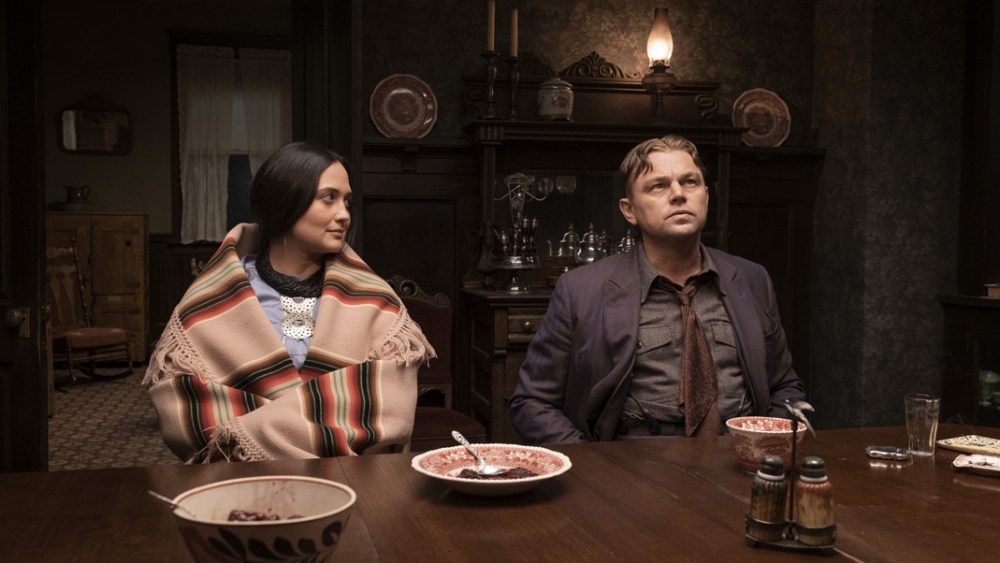
While Mollie is a key fixture throughout the film—as in the book, the violence seems to spiral out from her steady center—the narrative certainly hews heavier in Ernest’s direction, and Mollie largely disappears from the film’s final—and weakest—act, which depicts the aftermath of White and his lawmen appearing in town and the subsequent courtroom drama that unfolds. The latter is Killers of the Flower Moon at its most ubiquitous, and it isn’t aided by the histrionic performances of John Lithgow and Brendan Fraser as the prosecutor and attorney. DiCaprio’s performance isn’t necessarily in that same vein, but he does feel miscast, both for the character he’s playing—Ernest was, in reality, younger than Mollie, and there are stretches when DiCaprio’s age doesn’t completely gel with the tool he’s portraying—and the tone of the film. DiCaprio is a big actor, the sort who tends to suck all of the air out of every scene he appears in. It’s the reason why he’s one of the last true movie stars. But that performance style suits a character like stockbroker Jordan Belfort in The Wolf of Wall Street, where his hunger for money and power is reflected visually in the film’s excess. It doesn’t mesh as well with a character like Ernest Burkhart, who is essentially the intermediary between Mollie and Hale, hiding his true intentions with the former, and getting bullied around by the latter (although, the power of DiCaprio and De Niro together is unmatched, particularly in one scene, where Hale brings Ernest into a lavish, chessboard-tiled room, forces him to bend over a podium, and spanks him mercilessly with a paddle). It’s not that he’s turning in a poor performance—he isn’t, even if the frown that seems permanently drawn across his face gets tiresome after three hours—and he does straddle the fine line of whether or not Ernest truly loves Mollie even as he’s abusing her and her family quite brilliantly over the course of the movie (I’m not sure that he would have been better for the role he was originally intended for, however, that of agent Tom White). His theatrics stand in stark contrast to Gladstone’s stoic and soulful portrayal of Mollie. Hers is the performance of the year, conveying so much just with her deep and expressive eyes, any joy she possessed at the start of the film fast giving way to the weight of the pain of witnessing family member after family member die tragically.
You can debate back-and-forth—and I’m sure people already are—whether or not Killers of the Flower Moon is a “good” representation of the Osage murders, and of the Osage people. Frankly, it doesn’t place the Osage themselves in front of the camera for nearly enough of its runtime to merit as much praise in that area as I would like to give it. But what Scorsese accomplishes here is still an impressive feat, even within his storied filmography. I mentioned before that Grann’s book reads like a thriller; Scorsese’s film is more a family drama, with a strong emotional core that hits hard despite its faults. Grann’s book is one way of telling the story. Scorsese’s film is another, one that book-ends itself with its own depiction of how we tell stories and pass on our knowledge of history. Killers of the Flower Moon opens with a silent movie newsreel detailing the Osage wealth, set to Robbie Robertson’s percussive score that thumps like heart-beats over the course of the film (this is the musician and frequent Scorsese collaborator’s final work; the movie is dedicated to his memory). And the movie ends with—well, I’ll avoid spoiling exactly what it is here, but Scorsese eschews the typical postscript finale for a giddy flourish that is far more cinematic. This is the director and editor Thelma Schoonmaker at their liveliest, and what could have, in less capable hands, read as too light a note to conclude such a gutting film on, manages to bring home the sobering nature of the incident and the failure to serve proper justice, and bring it all back to Mollie. That particular presentation within the film is one way her story gets told. I think now that it won’t be the last.
Killers of the Flower Moon is now playing in theaters. Runtime: 206 minutes. Rated R.

 Katie at the Movies