In 1993, Chen Kaige’s Farewell My Concubine, a sumptuous, decades-spanning epic based on the Lilian Lee novel, became the first Chinese film to win the Palme D’Or at the Cannes Film Festival, tying with Jane Campion’s period drama The Piano. One of the most notable works from who would become one of the most notable figures in Chinese Fifth Generation cinema, a movement which saw the emergence of a new group of filmmaking talent immediately following the end of the Cultural Revolution, Farewell My Concubine exemplifies that era both in its reception— it was met with worldwide acclaim and recognition in a way that few Chinese films had been before— and its themes, freely condemning the Cultural Revolution and its destructive impact on Chinese art and culture through the eyes of two players in a famed Peking opera troupe. As rapturous as its reception was at Cannes, however, Chinese officials temporarily banned it from release due to its political subject matter, in addition to its portrayal of homosexuality and suicide. Even more perplexing, however, were the edits imposed on the film by Harvey Weinstein, who purchased the U.S. distribution rights to Farewell My Concubine out of Cannes for his company Miramax Films— and proceeded to cut approximately 14 minutes from the 171 minute film, a puzzling move that prompted that year’s Cannes jury president Louis Malle to state, according to Peter Biskind’s 2004 book Down and Dirty Pictures: Miramax, Sundance, and the Rise of Independent Film, “The film we admired so much at Cannes is not the film seen in this country, which is 20 minutes shorter— but seems longer because it doesn’t make any sense. It was better before those guys made cuts.”
Chalk up the mangling of Farewell My Concubine as one of the lesser sins committed by Weinstein during his time working in the industry. The fact remains that, as well received as the movie still was (even obtaining two Academy Award nominations), the uncut version of the film has never been released theatrically in the U.S., and has otherwise been difficult to come by. But a beautiful new 4K restoration of the movie by Film Movement Classics has brought Farewell My Concubine back to the big screen, with all of its previously cut material restored.
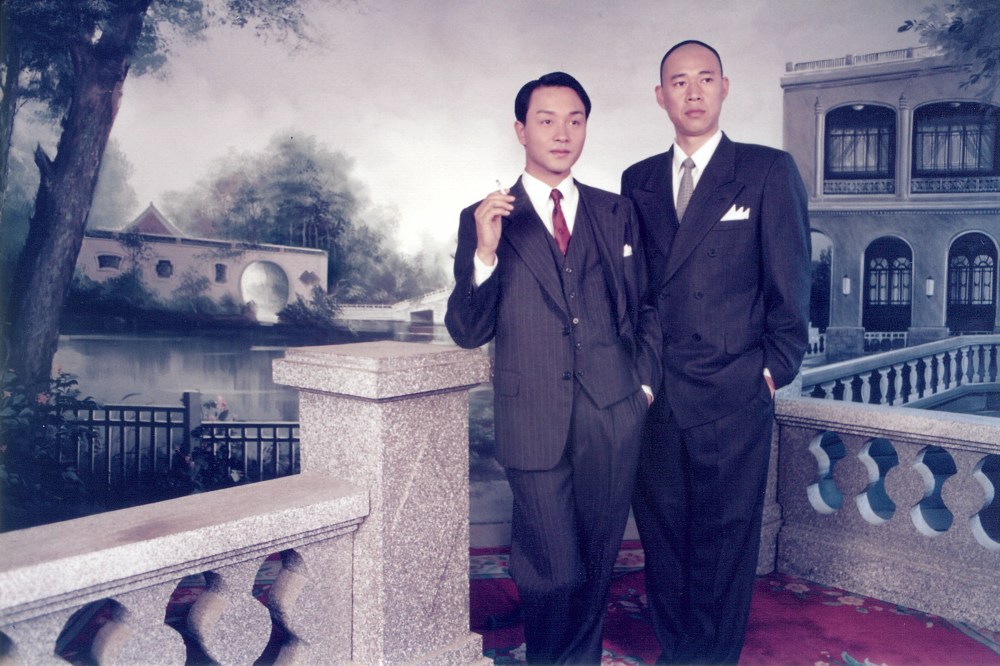
Farewell My Concubine is a decades-spanning epic that opens in 1977 with Peking Opera stars Douzi (Leslie Cheung) and Shitou (Zhang Fengyi) reuniting for a performance and reflecting back on their lives and careers. As a child, Douzi was dropped at the all-boys Peking Opera Academy by his impoverished, prostitute mother. The training, under the supervision of Master Guan (Lü Qi) is physically intense but also incredibly abusive, every transgression resulting in shaming and beatings. He befriends fellow student Shitou, and the young actors playing the characters as children and teenagers deliver remarkably intelligent and natural performances that makes the adult situations they are subjected to that much more difficult to endure.
As adults, the two men adopt stage names— Douzi becomes Cheng Dieyi and Shitou becomes Duan Xiaolou— and become famous performing in the opera Farewell My Concubine. Xiaolou plays the hero, and Dieyi— whose delicate features made him the subject of ridicule at the Academy but allow him to take on feminine roles— portrays the concubine who dies for her master. If the training sequences that dominate the first leg of the film examine how dedication to art can physically break down a person, the remainder of the film shows how it mentally can, with Xiaolou and particularly Dieyi’s real identities becoming fractured: first in the adoption of new names, and later in the line between their performance and their reality becoming increasingly blurred. As children, Xiaolou offers to one day gift a sword to Dieyi, as a hero would to his concubine, and Dieyi really does love Xiaolou. But their relationship turns complicated with the introduction of Juxian (Gong Li), a courtesan who Xiaolou marries. Feelings of jealousy and betrayal escalate in time with the political upheavals across the country, and the threesome gradually crumble.

Farewell My Concubine luminous cinematography and ornate costuming and production design that one would expect from an epic of this scale, and it looks especially glorious in this restoration. At the same time, Chen utilizes few of the sprawling set-pieces normally associated with such films, concentrating instead on more intimate scenes populated predominantly by his core handful of lead actors. The expansive nature of the story and its complex mix of personal and political themes is never sacrificed at the expense of that, but the overall work is remains daring, even 30 years after its initial release, for its clear and honest portrayal of the effect the violence and oppression of the Cultural Revolution had on individuals, art, and the country at large. The finale, tragic as an opera, is heartbreaking, brought home with a particular emotional clarity through Gong Li’s firm grasp on Juxian’s strengths and vulnerabilities (no wonder she quick became a global superstar) and Cheung’s smoldering intensity, which conveys feelings that aren’t overt on paper. Farewell My Concubine’s rerelease is a particular reminder of Cheung’s power as a performer, and of his loss way too soon (Cheung passed away in 2003). I haven’t seen the Weinstein hack-job cut of Farewell My Concubine, so I can’t comment on what a difference the restored edits make to the film. What I do know is that Chen’s epic, viewed as he originally intended it (and still, 30 years later, the only Chinese film to win the Palme D’Or) is as sumptuous and riveting a film as I hoped it would be, and more.
Farewell My Concubine is now playing in select theaters, and screens locally at the Hi-Pointe Theatre October 13-19. Click here for tickets and showtimes. Runtime: 171 minutes. Rated R.

 Katie at the Movies