Indiana Jones has always been about the past. He is an archaeologist, after all, and his exploits, from the Ark of the Covenant in Raiders of the Lost Ark to the titular artifact of Kingdom of the Crystal Skull, have always married the past with his present day, typically with a supernatural twist. But the past hasn’t always meant nostalgia for Indy, even when it came to the latter movie, the fourth installment in the original series of films which ran from 1981 to 1989; when Indiana Jones and the Kingdom of the Crystal Skull was released in 2008, Hollywood hadn’t quite yet hopped on the bandwagon of nostalgia-based sequels and reboots. Moreover, the Walt Disney Company hadn’t yet purchased Lucasfilm from Indiana Jones creator George Lucas. Indiana Jones and the Dial of Destiny, the fifth and reportedly final film in the series, is the first Indy movie to be made and released under Disney, and the first without the direct involvement of Lucas or Steven Spielberg, who directed all of the previous four movies. James Mangold takes his place in the director’s chair, while four writers, including Mangold and David Koepp (who worked on Crystal Skull) share credit on the long-gestating screenplay. That behind-the-scenes shift shows in the final product. Dial of Destiny exists in the curious space of being neither boring nor exciting, but simply just being, the film’s obvious attempts to recreate both the story and character dynamics that made the original run of movies so classic and rewatchable resulting in a throwback to pulpy adventure stories that lacks the pizazz and fun of the works that inspired it.
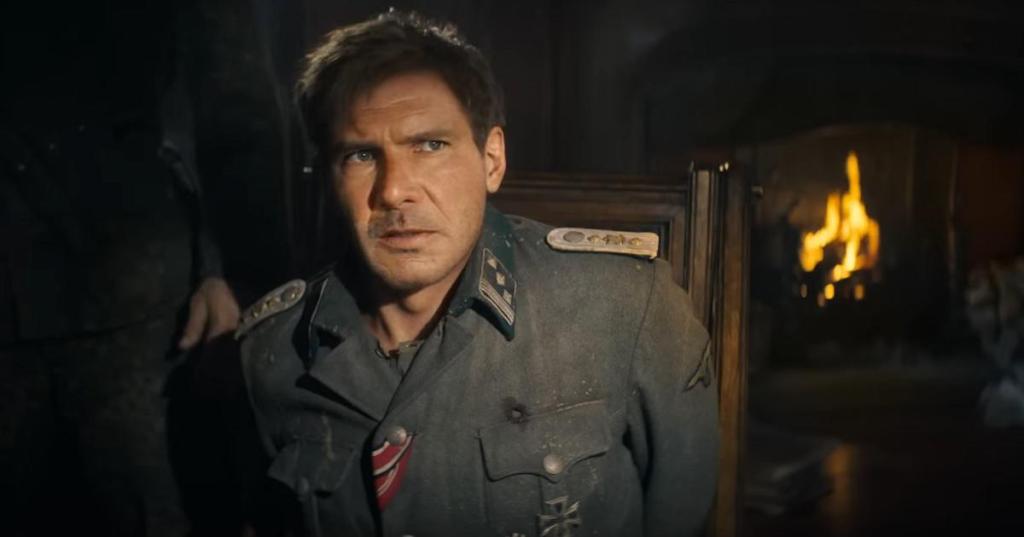
That Dial of Destiny is more rooted in nostalgia for what came before than its predecessors is apparent from its lengthy opening, set during the Allied liberation of Europe in 1944. Indiana Jones (Harrison Ford) and fellow archaeologist Basil Shaw (Toby Jones) are captured by Nazi astrophysicist Jürgen Voller (Madd Mikkelsen) while trying to retrieve a prized artifact. The sequence, which contains a chase, a gunfight, impersonation, and a daring escape, concludes with Indy and Basil making off with half of the Archimedes’s Dial, a compass-like object invented by the legendary mathematician to locate fissures in time (time travel, essentially). That this opening is trying to recapture the excitement of the World War II antics that were so prevalent in the previous movies is clear, and for a while, it sort of accomplishes that. Mikkelsen’s face is slightly and convincingly de-aged for this sequence, but some more complex face-scanning technology was used on now-80-year-old Harrison Ford to bring him back to his appearance from around the time of Raiders. When Ford isn’t moving, the result is scarily impressive. But when he speaks, his computer-generated face becomes just apparent enough, plunging us into that ever-so-unsettling uncanny valley, his unaltered voice sounding too mature for his face, and when he walks, he possesses the gait and stature of an older man. For the brief amount of time that he appears in the movie in this way, the effect is serviceable, but it also sets the tone for so much of what is to follow: a half-hearted attempt to chase after what once was instead of taking bold new steps in a new direction.
Interestingly, the clash between past and progress that is baked into the fabric of Dial of Destiny’s creation is also a key theme in the setup of its plot. When we catch back up with Dr. Jones after the World War II opening, it’s 1969. Indy appears almost immediately in the cliched guise of an old man who is out of touch with the youth; he awakens in his New York City apartment with a start, the rock music booming from a neighboring apartment, pulls on a shirt, grabs a baseball bat, and goes to confront the apathetic young partiers. Later on, we see that he is still a university professor, teaching about ancient civilizations, but whereas in his younger days he held his students in rapt attention (granted, that probably had more to so with his physical assets than his lesson plan), when Mangold cuts from Indy’s enthusiasm verging on desperation to the students, they appear distracted and distant. And the the present literally invades the past: a group of students suddenly burst into the classroom to roll in a TV set, interrupting Indy’s lecture about the ancients with a broadcast celebrating the return of the Apollo 11 astronauts from their mission to the moon. It’s Moon Day, and a parade (and a Vietnam War protest) is gathering on the city streets outside. This is the modern world, and it seems like there is no room for Indy in it; in the very next scene, we see that his bosses are pushing him into an early retirement.
These more thoughtful themes and character beats are by and large dropped, however, when Helena Shaw (Phoebe Waller-Bridge) pops into Indy’s life. She’s his goddaughter who he hasn’t seen in years, the daughter of his friend Basil Shaw, who we met in the opening. We learn that Basil became increasingly obsessed with the Dial and its possibilities right up until his passing, and now Helena, an archaeology student conducting studies of her own, is trying to discover more about. But there are some bad folks hot on Helena’s trail looking for the Dial for their own nefarious reasons, namely Voller, who has buried his Nazi past and now works for NASA under a new identity.
Their pursuit leads to a globetrotting adventure that takes the characters from NYC to all over the Mediterranean. Dial of Destiny does, on a surface level at least, checks all the boxes for a good old-fashioned adventure yarn. There are exotic locales and all manner of side characters met along the way (Antonio Banderas is a welcome new face as a deeper sea diver who aids our heroes). There are puzzles to be solved, and sets and chase scenes that move with all the energy of a theme park ride. Familiar character dynamics are established in relation to Indy as well: the plucky heroine (Helena), the quick and clever kid (Helena’s sidekick Teddy, played by Ethann Isidore). And yet, despite possessing all the elements we love to see in an Indiana Jones movie, it’s missing that special spark. Much of that can be attributed to the script, which concocts an intriguing new MacGuffin for Indy to chase that is very much in line with what we’ve seen from this series before (even though the finale takes a decidedly absurd turn; frankly, I was along for the ride for that part), but conjures such dull dialogue and situations out of that. Mikkelsen’s Voller is a competent if not particularly memorable villain, whose intriguing background (the Nazi-to-NASA pipeline) is squandered. The turns Waller-Bridge’s Helena takes, however, border on obnoxious. Mangold cited 30s and 40s screwball comedy heroines as her main inspiration, namely Barbara Stanwyck’s turn as Jean Harrington in Preston Sturges’ 1941 comedy The Lady Eve. The fact that Harrington was a con artist out to fleece a naive but rich man is in line with Helena’s character, but while Waller-Bridge is fairly adept at that rat-a-tat delivery that’s a requirement for the quick pace of those films, she’s never given anything genuinely witty to say. Instead, she’s forced to read such cringe-inducing lines as “You stole it. You stole it. Then I stole it. It’s called capitalism.”

The film also sorely misses Spielberg in its direction. The composition and pacing of the action scenes lack a certain kinetic energy needed to elevate them above merely being just fine. They also fall into the trap that so many action movies do nowadays: a little too much CGI, a little too much murkiness in their environments (a lot of the action-heavy scenes take place at night, or underwater, or in caves, but that doesn’t mean they can’t be lit). And then there’s the whole nostalgia situation. This isn’t as big a problem in Dial of Destiny as it is in other franchises. The winking nods to the other movies are kept to a minimum, and Marion Ravenwood’s scene (which finds Karen Allen reprising her role) is crucial to the story and probably the strongest part of the movie. But other times it feels like Dial of Destiny is trying to round up familiar faces for one last hurrah; there’s no reason for John Rhys-Davies’ Sallah (who was last seen in The Last Crusade) to be here, and regardless of your love or lack thereof for the character, the Welsh actor playing an Egyptian man is probably the last thing that needed to be brought back in 2023.
Unfortunately, there are also times in Dial of Destiny where it feels like Indy is slightly pushed to the side. But the film makes up for that with its surprisingly moving final act, allowing Ford a showcase for his talents and some of the best work of his career. The finale resurrects that idea put forth in the beginning about Indy being a man out of his time, and Ford appears perhaps the most vulnerable he’s ever been, tears trembling in his eyes as he expresses how there is no longer anything or anyone for him in the present day. It might be giving the screenwriters a little too much credit to apply a meta reading to this, but I think you can find in the place where Indy ends up at the conclusion of Dial of Destiny an assertion that, in a blockbuster movie landscape dominated by superhero and futuristic fare, there’s still a spot for Indiana Jones. As I mentioned at the top, this is supposedly the finale Indiana Jones film; at the very least, the final one for star Harrison Ford. But in a media landscape that is as soaked in nostalgia-based IP as ours currently is, it wouldn’t surprise me at all to see that fedora and hear the crack of that whip again in some capacity in the future.
Indiana Jones and the Dial of Destiny is now playing in theaters. Runtime: 154 minutes. Rated PG-13.

 Katie at the Movies
I was looking forward to your review on this and wasn’t disappointed. 🙂
LikeLiked by 1 person
Yay, thanks for reading!
LikeLike
Good review. I felt that the movie was just okay. Definitely had its moments of nostalgia and Ford was still terrific as Indy, but the movie itself felt bloated, long, and clunky in a few crucial areas. Definitely better than Crystal Skull, but not as good as the original trilogy.
LikeLiked by 1 person
Thanks! I think I actually like Crystal Skull better, haha. But it’s a testament to the quality of Ford’s performance that he made me legitimately cry at the end of a movie that I was otherwise disinterested in up to that point.
LikeLiked by 1 person