There are your run-of-the-mill superhero movies that dominate theaters these days, and then there’s Spider-Verse. Sony Pictures Animation’s 2018 feature Spider-Man: Into the Spider-Verse, which thrust Miles Morales (an Afro-Latino Brooklyn teen who takes up the mantle of Spider-Man and a less-than-familiar face outside of comic books) into the center of the narrative. It’s a movie that I have no qualms about calling perfect, from its immaculately-executed narrative arc to its compellingly written and performed characters to its animation, a breath of fresh air from the usual 3D style that is utilized by most major animation studios, the graphic nature of which beautifully replicated comic-book artwork. It’s a movie so dang good, it’s difficult to imagine any of the inevitable sequels meeting it on its level, not to mention surpassing it. And that’s about where I’ve landed on the series’ second installment, the first half of a two-part story: Spider-Man: Across the Spider-Verse, in which the artistic boundaries are pushed even farther, while the more expansive narrative resonates less.
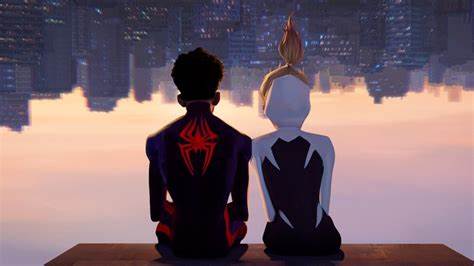
It’s been a little over a year since the events of Into the Spider-Verse. Miles (Shameik Moore) is still adapting to being Spider-man (after stepping in for his reality’s deceased Peter Parker), all while feeling disconnected from his parents Jefferson (Brian Tyree Henry) and Rio (Luna Lauren Vélez) from whom he’s still hiding his superhero alter-ego, and missing his spider-friends from other dimensions, particularly Gwen Stacy/Spider-Woman (Hailee Steinfeld). Just when Miles is feeling at his lowliest and loneliest—grounded by his parents after first being late for a school counselor meeting and then for a party celebrating his father’s promotion to police captain because he was fighting off a supervillain—Gwen suddenly materializes. She’s now a member of the Spider-Society, a group of spider-people from many different dimensions led by Miguel O’Hara, aka Spider-Man 2099 (Oscar Isaac), and while she reconnects with Miles, she’s actually on his Earth to track the villain who has been plaguing him all day, the Spot (Jason Schwartzman), an initially harmless villain-of-the-week whose body consists of many interdimensional portals. Miles follows Gwen, meeting new teammates—like the rebellious Hobie, aka Spider-Punk (Daniel Kaluuya) and the seemingly-perfect Spider-Man India (Karan Soni)—and reuniting with old ones, namely his mentor Peter B. Parker (Jake Johnson). But he discovers that with being Spider-Man comes certain events he cannot alter—at the risk of destroying his universe as a whole.
Into the Spider-Verse, with its bold, super-stylized effects animation and graphic art-inspired designs, expanded many viewers’ perception of not only what a superhero film could look like, but what a mainstream Hollywood animated feature— a medium quickly delineated by many as one reserved for kiddie fare— could be. The artists and animators behind Across the Spider-Verse, led by a new team of directors (Joaquim Dos Santos of Avatar: The Last Airbender and The Legend of Korra fame, Kemp Powers of Pixar’s Soul, and Justin K. Thompson) and writers (Phil Lord joined by David Callahan and co-producer Christopher Miller) manage to take the creativity and imagination of their craft up another notch, firstly by developing unique art styles for each of the six dimensions the film is set in, creating the illusion that each world and its inhabitants are from different comic books drawn by different artists. Even more so than with Into the Spider-Verse, Across the Spider-Verse frequently looks and feels wildly experimental. Take, for example, the sketchy, inky lines that accompany the Spot. The line-work is rough but lively, the pencil under-drawings just barely perceptible underneath. There’s a lovely watercolor style used for Gwen’s dimension, featuring a delicate pastel palette and fluid animation that pulsates in tune with Gwen’s emotions. Spider-Punk’s decidedly 2D look, meanwhile, mimics a collage of pasted-together bits from pencil drawings and magazine clippings. The kinetic pace of the action scenes, with their quick bursts of color and many myriad characters moving in and out of the frame, borders on neurotic, but it’s never so chaotic as to render them indecipherable or overwhelming. The camera moves in dynamic ways too, especially when turning in step with the movements of the spider characters, who are able to walk on ceilings and up walls. If there is any technical fault to be found in the film, it’s in the sound mixing, with at least a couple character dialogue tracks sounding too muted against the music and other sounds (I wasn’t going to mention this initially, believing it an issue with the volume in the theater I watched it in, but after seeing many other people commenting on having the exact same experience, I have to assume it’s a problem with the mix itself).
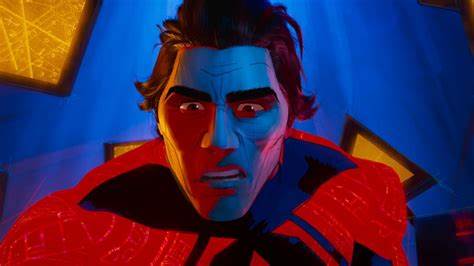
As gob-smacking as Across the Spider-Verse is on an artistic and technical level, however, the story widens its scope and takes some big ambitious swings that are engaging, but sacrifice some of the emotional weight that resonated so strongly in the more-focused narrative of its predecessor in the process. This is especially true of the film’s second half, revealing a conflict that only becomes more overstuffed and convoluted as the story barrels toward its non-ending. I can’t envision a more effective stopping place for the first part of this story (which will be continued next year in Beyond the Spider-Verse), but it is so thoroughly part one of a narrative that has yet to be finished, and whether you were aware of that going into this movie or not, its cliffhanger ending is rather jarring. While the potential conflicts the climax of Across the Spider-Verse sets up are intriguing to consider (and the twist that concludes the film is pretty nifty), the emotional beats of this film emerge strongest in throughout its first half, pondering themes of isolation, and feeling both stifled by and eager to make your parents proud. Both Gwen (who the film opens with) and Miles go through these experiences with their families; Gwen has more of a fully formed arc, while Miles’ still needs to be resolved in the next part. And there is a continuation of one of the over-arching ideas of the first movie, that we— anyone— has the power to tell their own story, which becomes the key to this film’s primary conflict, when deviating from the “canon timeline”— even for noble reasons— could have devastating consequences. The MCU and DCEU, with their many overlapping installments, may have rendered the concept of the multiverse tired, but movies like Spider-Verse reinvigorate it. It doesn’t work one hundred perfect, but it possesses the conviction in its universe and its characters that make you believe in it all the same.
Spider-Man: Across the Spider-Verse is now playing in theaters. Runtime: 140 minutes. Rated PG.

 Katie at the Movies