The landscape of Almería— a port city that sits on the Mediterranean Sea in southern Spain— is defined by desert plains and craggy hills. Within this arid country, connections to nature and the land are everywhere. It’s first and foremost present in the greenhouse where Iván (Silver Chicón) and Hadoum (Herminia Loh) are employed, harvesting, inspecting, and packing tomatoes to be shipped all over the continent. And it’s present in the beach where the couple first rendezvous on the shadowy, stony shore, and later in a greenhouse, whose thermal camera picks up their body heat as the two become one.
It’s a gorgeous setting for a classic romance, but writer and director Ian de la Rosa’s debut feature film Iván and Hadoum eschews tradition more than it adheres to it. Iván’s first brush with Hadoum isn’t so much a meet-cute as it is an early indication of workplace troubles to come: she, a new employee in the company owned by Iván’s family and where he’s pushing to be promoted to a managerial position, is struck by a forklift in the warehouse. He’s transfixed by her further when he happens upon her singing karaoke, a tender ballad from her native Morocco, his male companions’ cutting remarks about her past and her appearance fading into the background. They sleep together that night, and while Hadoum insists that that encounter doesn’t mean anything, the couple keep finding themselves pulled to each other, their mutual attraction made more real by Chicón and Hadoum’s easy chemistry and de la Rosa’s loose script that allows room for improvisation in the more intimate moments.
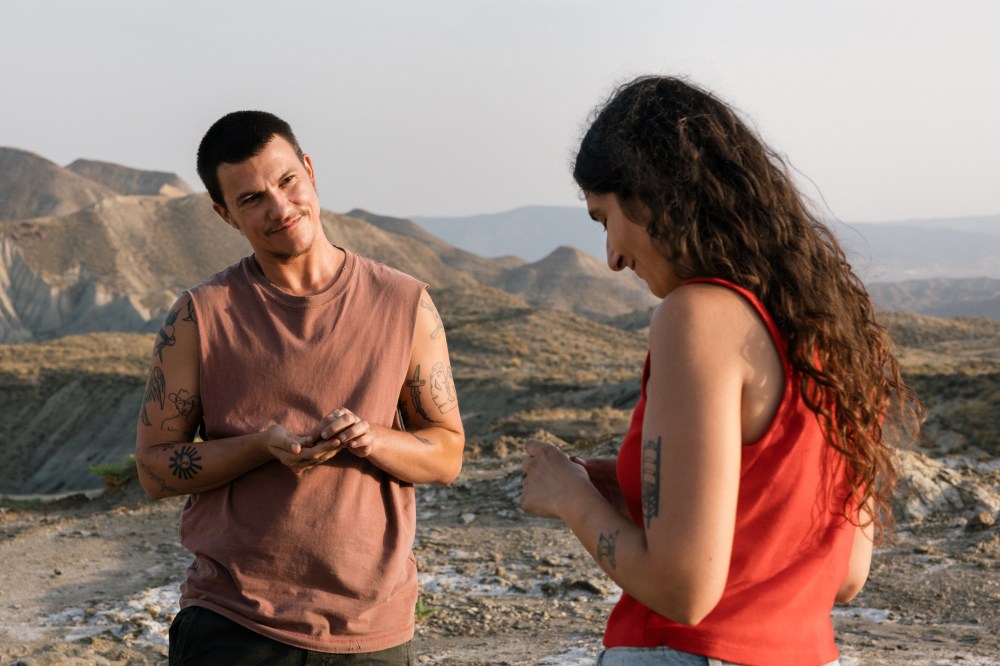
Like any romantic drama, there are obstacles that stand in the way of Iván and Hadoum’s happiness. Iván is caught between his family— his uncle’s pending sale of the company would further boost their financial and social status, permitting them to purchase a dream, ocean-view apartment— and Hadoum, whose immigrant status automatically isolates her from the more xenophobic members of the community, while she also aligns with her fellow packers in opposition of the sale, which would likely lead to layoffs for them, and advocating for better, safer working conditions in the warehouse. That tension— not to mention the fact that neither of the couple’s families approves the other— mounts until it becomes possibly too rocky for them to navigate.
That all may sound overly familiar (and the film’s conflicts wrap up rather quickly and tidily) but Iván and Hadoum’s most interesting characterizations manifest themselves in its margins. While his family appears to be close and content and easy-going (de la Rosa’s camera pulls back to fit the large group in the frame at family dinners, cementing their portrayal as a unit), there is some implied resentment surrounding Iván’s uncle taking over the company from Iván’s late father. Iván is a transgender man, but this is a fact that the film allows to breathe without making a point of rendering it explicitly, or a central piece of the narrative’s conflict. His orientation, however, aligns him with Hadoum as a fellow outsider; his family may accept him (there’s a profoundly moving line about how his mother gave birth to him twice, once as a baby and again when she paid for his surgery, while the teasing, easy kinship he shares with his sister extends to her being comfortable enough around him to share a bathroom at the same time) but others in their town dismiss Iván, referring to him as a “hybrid.” That could be why, despite all the logical reasons to believe that they wouldn’t make a good couple, Iván and Hadoum immediately find so much solace in each other. Their romance is accentuated by Beatriz Sastre’s cinematography, which warmly captures the town, from the interiors of the warehouse to the waves lapping at the shore to its bustling nightlife, granting Iván and Hadoum a sense of place that— regardless of its abrasive features— feels as familiar and welcoming and swoonily dramatic as the titular characters’ honest conversations, passionate embraces, and shared glances that convey feelings that words cannot.
Iván and Hadoum had its world premiere in the Panorama section at the 2026 Berlinale. Runtime: 100 minutes.

 Katie at the Movies