Below, you can find some of my notes from a brief talk I recently gave preceding a screening of 1932’s Red-Headed Woman at East Central College in Union, Missouri. This was actually the second time I’ve had the chance to present this movie— a true pillar of pre-Code cinema, for many reasons— and it was a pleasure to dive into the making of the movie, how it straddles a line between comedy and drama that was integral to whether or not it was perceived to be compliant to the Motion Picture Production Code, and the radical nature and enduring appeal of star Jean Harlow’s screen persona.
I first became interested in pre-Code movies when I was in high school, and had recently become very passionate about film in general, but Old Hollywood in particular. It was in the course of watching films featuring stars and subject matter I was interested in that I stumbled upon pre-Code and what it was. My memory of that time is a little fuzzy, but I’m pretty sure the pre-Code movie that first made a mark on me was 1931’s Night Nurse, which is still my favorite pre-Code movie today and is such a deeply amoral film that was so shockingly different from the other Golden Age films I’d seen that I immediately began learning more about this era and watching as many films from this time as I could get my hands on.
So what is pre-Code? I complied a sort of Cliffnotes overview for anyone who has wandered in here without a lot of context, especially as it’s pretty integral to understanding what made the film we are watching tonight so shocking at the time it was released. Pre-Code is an era of Hollywood movies released from around the start of talking pictures in 1929 until July 1, 1934, when the Motion Picture Production Code— also known as the Hays Code, named after Will Hays, the president of the Motion Picture Producers and Distributors of America— was not being strictly enforced. So the name “pre-Code” is a misnomer because there was actually a code in place at the time. It was signed off on by all the major studio heads in 1930 as a method of self-censorship to avoid outside government regulation, as there was mounting pressure from religious and civic organizations to clean up the film industry. This had been going on since the silent film era, when numerous scandals involving filmmakers and movie stars like the Fatty Arbuckle rape trial prompted many to question the morality of the film industry. But the men in charge of the Studio Relations Committee (SRC) that was tasked with enforcing the Code— first Jason Joy and then James Wingate— were pretty ineffectual and didn’t really have the authority to do much more than advise studios on what kinds of changes they should make to their films, and that paired with the Depression leading studios to lean in to making movies that contained more racy and violent content so they could sell more tickets was the cocktail that led to the transgressive nature of Hollywood films that was unique to these few years, and would all but disappear once strict enforcement of the Code began.
That’s not to say there isn’t some merit to how some filmmakers would employ clever methods to try to circumvent the Code restrictions— Alfred Hitchcock, for example, was great at this, with scenes like the train entering the tunnel at the end of North by Northwest or the prolonged kissing scene between Cary Grant and Ingrid Bergman in Notorious— but in pre-Code films it’s all on the surface, and I always find that when I introduce people who are only familiar with 40s and 50s Hollywood films to a pre-Code movie, they’re pretty surprised, because Code-era films often contain rather sanitized scenarios that create a false perception of what reality was like back then for modern viewers, whereas pre-Code movies dealt frankly with matters in a way that is a closer reflection of reality and how people talk and behave even today.
The movie we are watching tonight is a prime example of that, specifically the sex pictures led by powerful, sexually liberated women that became quite popular at this time. It’s 1932’s Red-Headed Woman from MGM, directed by Jack Conway from a novel by Katherine Brush, and starring Jean Harlow as Lil Andrews, a working-class woman who uses sex to advance her social position, first by seducing her married boss, who is played by Chester Morris.
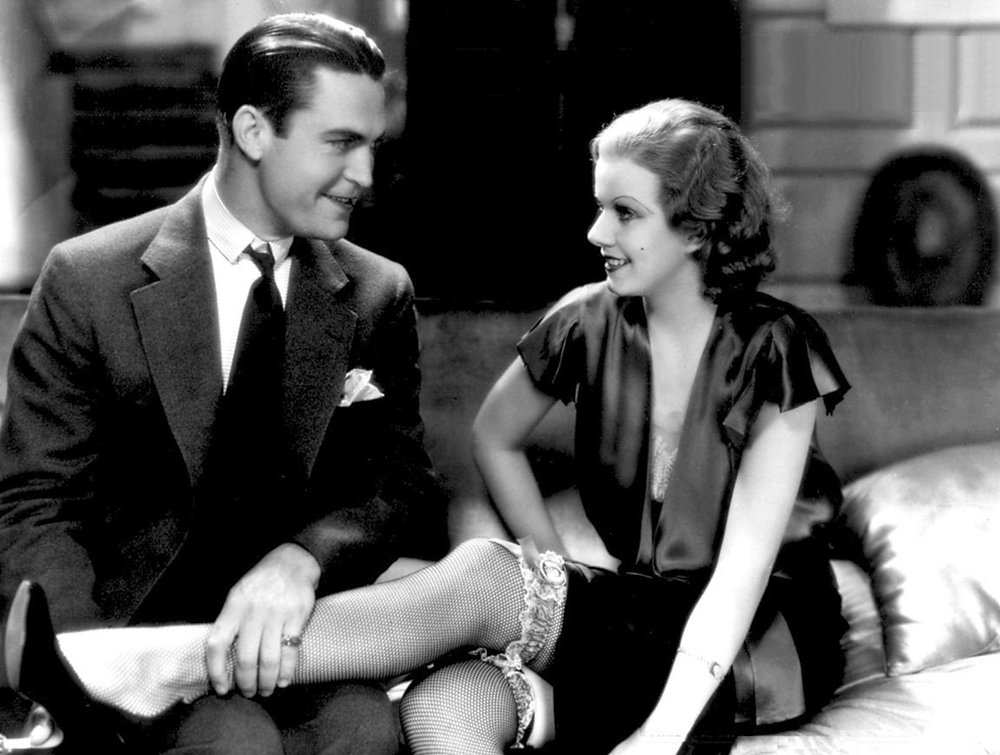
The making of this movie was somewhat fraught. F. Scott Fitzgerald and another male writer were initially hired to adapt the novel. Fitzgerald’s personal and professional life were in a downswing, so he was taking a lot of script jobs at this time. But the producer, Irving Thalberg, was concerned that his script was too dramatic, so he hired Anita Loos to rewrite it. Loos was best known for her comic novel Gentlemen Prefer Blondes, and Thalberg told her to “make fun of its sex element” for Red-Headed Woman like she did in Gentlemen Prefer Blondes. This was important, because the reception of the film as either a drama or comedy was integral to whether or not it was perceived to have passed the Code. If it was a drama, viewers may take Lil’s actions too seriously. If it was a comedy, it wouldn’t seem as much like it was condoning her actions because viewers would be laughing at her.
I found a wide range of different responses to the film on this matter. Lamar Trotti of the SRC, after screening the film privately, called it “the most awful script I have ever read” and accused the filmmakers of “playing it as a broad burlesque and that the audience will laugh at the situations as broad comedy. Maybe so, but that isn’t in the script.” Jason Joy, the head of the SRC, meanwhile, wanted to pass the film as is after screening it privately and then with a responsive audience at the theater, saying, “My feeling is that this picture is either very good or very bad, dependent on the point of view of the spectator who sees it as either farce or as heavy sex,” and, “In the cold projection room it seemed entirely contrary to the Code…when seeing it was an audience, it took on an entirely different flavor. So farcical did it seem that I was convinced that it was not contrary to the Code.” Meanwhile, there were also people from state and local groups protesting the movie, like a woman in Atlanta who said, “We have been working for years for clean decent pictures and here in 1932 we have THIS…Sex! Sex! Sex! The picture just reeks with it until one is positively nauseated.”
Ultimately, the film was passed, but not before the makeover prologue was added to ensure that Lil was perceived as more playful than mercenary, as test audiences otherwise didn’t know whether to laugh at her or not. I think Jean Harlow’s performance is key to this film’s success, because on paper Lil is a pretty unlikeable character. In his book Complicated Women, Mike LaSalle describes her as “unstoppable, a man’s nightmare present in comic terms.”
Having a female writer on this movie really made a difference here, as Anita Loos knew how to write funny women, and she could see that Harlow possessed comic potential. Red-Headed Woman marked a turning point in Harlow’s career, because by 1932 she was very famous, but she was miscast in many projects and wasn’t well-regarded as an actress. She achieved global stardom after Howard Hughes cast her as the female lead in his 1930 war movie Hell’s Angels, and was known for her platinum blonde hair and for being a sex symbol, but when you watch her in some of these early projects, even The Public Enemy opposite James Cagney, she’s kind of bad, and appears uncomfortable. Red-Headed Woman took advantage of her natural talents and took away her blonde hair— her opening line of the movie when she’s getting her hair dyed red is wonderfully meta and sets up her character perfectly.
I have a few quotes here that elaborate further on the effectiveness of her screen persona from Red-Headed Woman on. Film critic Stephen Whitty said of her, “With hair the color of white gold, an impish smile and a figure that was made for satin sheaths, Harlow radiated sex. But unlike silent sirens such as Theda Bara or Louise Brooks, or contemporary stars such as Greta Garbo or Marlene Dietrich, Harlow’s passionate promises came without worries, without cares, without some awful ultimate price,” and that “it was sex itself that Harlow made look comfortable on screen. She didn’t present it as a joke, the way Mae West did, but she sure made it look like fun, for women as well as men. Her characters had no illusions, and few inhibitions.”
Critic Zita Short furthermore commented on how this specific screen persona of Harlow’s riled up so many religious and conservative groups who were pushing for stricter enforcement of the Production Code, saying, “Harlow represented a threat to this regressive perspective on women, as she suggested that life as a cunning, independent party girl could be a hell of a lot more satisfying than life as a repressed Catholic housewife. Her appeal stretched beyond that of other sex symbols because she always brought an edge of self-awareness to her performances. Over time, she would develop into a full-fledged comedienne and gain the ability to deconstruct her own persona. When she was confined to dramas that existed purely to capitalise upon her sex appeal, the public was encouraged to treat her as a dangerous, exotic beauty who was legitimately responsible for society’s moral decline. The threat she posed seemed less serious when she started appearing in comedies that forced puritans to wrestle with the fact that home-wrecking gold diggers could also be witty career gals who served as confidants to their close friends.”
I think those are really good reads on why, beyond her offscreen controversies and tragic life, Harlow is such an iconic screen presence even today, and why she makes Red-Headed Woman work even when her character is so single-mindedly self-centered and engages in so many despicable actions. She even, at one point late in the film in particular when confronted with the snobbery and isolation that comes with upward mobility, manages to conjure up some sympathy for her.
And then you have the ending, which is maybe the most transgressive part of the film, because it doesn’t go the way of a lot of pre-Code movies, some of the most scandalous of which will still skew toward convention at the last second to appease those conservative groups. I don’t want to spoil it, but Red-Headed Woman doesn’t do that, and doesn’t contain any sort of punishment aspect for Lil. In fact, there’s an implication that her “sinful” behavior will continue long after the credits roll.

 Katie at the Movies